LMT Holds Ground as Aerospace Peers Move in Different Directions
- williamvickey358
- May 12
- 3 min read
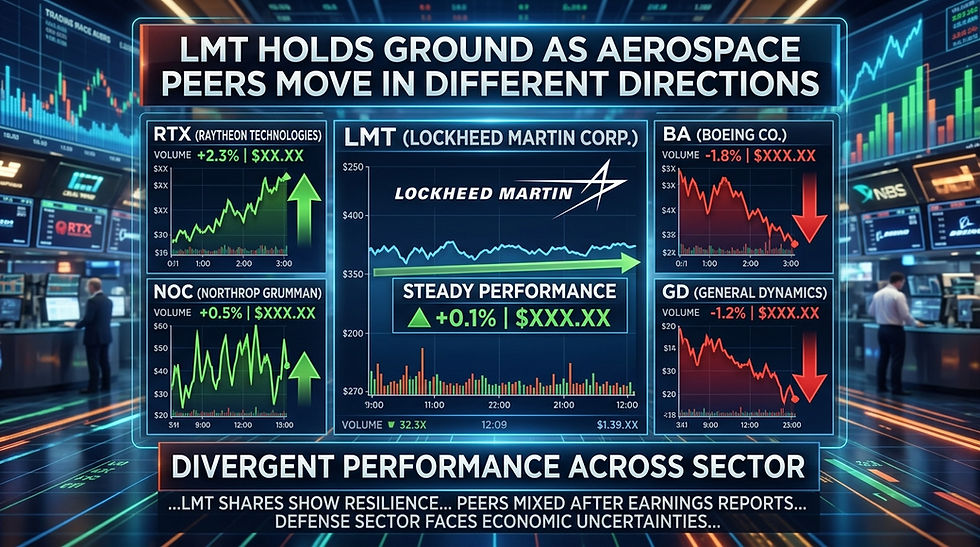
The defense sector stayed active on December 5, 2026, but LMT Stock showed more stability than several aerospace rivals. LMT continued trading near key technical levels while peers like Boeing and RTX moved sharply on sector news and broader market volatility.
Lockheed Martin remains one of the largest defense contractors worldwide. The company holds a market capitalization near $119 billion and trades with lower volatility than many industrial names. Recent data showed LMT trading around $510 to $515 during early May 2026 sessions. The stock’s 52-week range stands between $410.11 and $692.00.
The latest quarter also highlighted steady revenue generation. Lockheed Martin reported first-quarter 2026 sales of $18.0 billion, matching the prior-year quarter. Earnings reached $1.5 billion, while diluted earnings per share came in at $6.44.
Investors continue watching defense spending trends, aircraft demand, missile contracts, and geopolitical risks. Those factors continue driving attention toward LMT Stock and its aerospace peers.
Why LMT Stock Stayed More Stable Than Aerospace Rivals
Defense Demand Continues Supporting Lockheed Martin
Lockheed Martin benefits from long-term government contracts and recurring defense programs. That structure often reduces sudden swings compared to commercial aerospace companies. While airline-related businesses react heavily to travel demand and supply chain issues, Lockheed’s revenue base remains tied to military spending and national security priorities.
Recent trading sessions showed LMT remaining relatively steady even when competitors moved aggressively. The stock traded near $512 while maintaining a dividend yield around 2.6% to 2.7%.
Several major programs continue supporting revenue visibility:
F-35 fighter jet production.
Missile systems and hypersonic development.
Space and satellite contracts.
Classified defense technologies.
Helicopter and naval systems.
That diversified defense portfolio helps explain why LMT Stock often behaves differently than commercial aerospace names.
LMT Stock Performance Compared With Aerospace Peers
Boeing, RTX, and Northrop Grumman Moved Differently
Aerospace peers delivered mixed trading action during recent months. Boeing shares gained from aircraft delivery optimism, while RTX reacted to engine and defense program updates. Northrop Grumman also moved higher on military demand expectations.
Recent market reports showed Lockheed occasionally lagging peers during strong market rallies. On April 17, 2026, LMT declined 2.52% to $592.19 while Boeing gained 2.06%. RTX added 0.29% during the same session.
Still, the long-term numbers remain competitive. Yahoo Finance data showed:
Metric | LMT | S&P 500 |
YTD Return | 6.50% | 7.18% |
1-Year Return | 11.69% | 30.29% |
3-Year Return | 21.93% | 77.39% |
5-Year Return | 50.25% | 73.35% |
The data suggests LMT Stock continues prioritizing stability and dividends over aggressive growth-style momentum.
Financial Metrics Investors Are Watching Closely
Revenue, EPS, Dividend, and Trading Volume Matter
Several financial indicators remain important for investors tracking Lockheed Martin. The company’s forward annual dividend currently stands at $13.80 per share after the latest quarterly payout of $3.45.
The company has also increased dividends for 22 consecutive years. That consistency remains attractive during uncertain economic periods. Market participants also continue monitoring cash flow after first-quarter operating cash fell to $220 million from $1.4 billion one year earlier.
Key numbers currently shaping sentiment include:
Market cap: about $118 billion to $123 billion.
Average daily trading volume: roughly 1.5 million to 2.0 million shares.
Forward P/E ratio: near 24 to 25.
Dividend yield: about 2.6% to 2.7%.
52-week high: $692.00.
52-week low: $410.11.
Those figures continue helping investors evaluate whether LMT Stock remains attractive compared with other aerospace and defense names.
What Could Drive the Next Move in LMT Stock
Defense Budgets and Global Tensions Stay Important
Future performance for Lockheed Martin likely depends on several major catalysts. Global geopolitical tensions continue supporting defense budgets across the United States and allied countries. Increased military modernization efforts may create additional demand for fighter jets, missile systems, and space defense programs.
Investors are also monitoring Pentagon contract announcements and export approvals tied to the F-35 program. Lockheed remains deeply connected to international defense partnerships, which strengthens long-term revenue visibility.
However, risks still exist. Supply chain disruptions, production delays, and government budget negotiations could pressure margins. Rising labor and manufacturing costs also remain important concerns for aerospace companies.
Even with those risks, many analysts continue viewing LMT Stock as a relatively defensive industrial play. The company’s lower beta and stable dividend profile support that reputation.
For investors following the aerospace sector, Lockheed Martin remains one of the most closely watched names because of its scale, contracts, and long-term defense exposure.


Comments