S&P BSE Sensex Falls 0.97% Amid Oil Price and Rupee Concerns
- williamvickey358
- Jun 9
- 4 min read
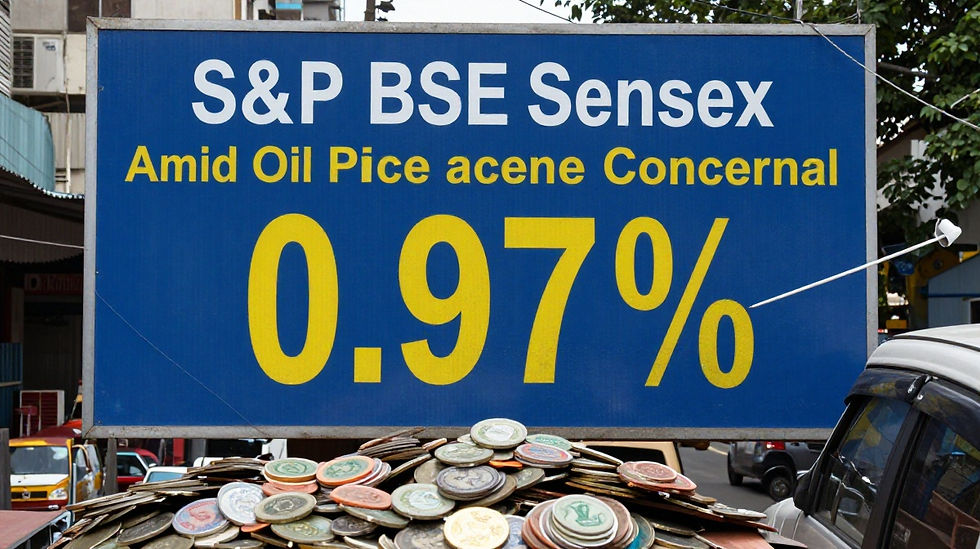
The S&P BSE Sensex came under pressure as investors reacted to rising crude oil prices and a weakening Indian rupee. The benchmark index closed at 73,524.26, down 719 points or 0.97%, while the Nifty 50 settled at 23,123.00, a decline of 1.04%.
The move reflected growing concerns about inflation risks, foreign capital flows, and global geopolitical tensions that pushed oil prices higher. On September 6, 2026, market participants remained focused on how elevated energy costs could affect India's economic outlook.
The decline was broad-based across sectors. Financial stocks, information technology companies, and several large-cap names contributed significantly to the fall. Investor sentiment weakened further as the Indian rupee slipped to 95.61 against the US dollar, raising concerns about imported inflation and higher input costs for businesses.
Although domestic institutional investors provided support through strong purchases, foreign investors continued to reduce exposure. The combination of oil price volatility, currency weakness, and cautious global sentiment created a challenging environment for the S&P BSE Sensex.
Why the S&P BSE Sensex Declined
Oil Prices Added Pressure to Market Sentiment
Rising crude oil prices became one of the biggest concerns for investors. Brent crude traded near $97 per barrel, driven by geopolitical tensions and supply concerns in global energy markets. Higher oil prices generally increase India's import bill because the country relies heavily on imported crude oil. This often leads to inflation concerns and pressure on the rupee.
The market reacted negatively because expensive oil can affect transportation costs, manufacturing expenses, and corporate margins. Investors often reassess growth expectations when energy prices rise sharply. As a result, selling pressure increased across several sectors, contributing to the decline in the S&P BSE Sensex. The relationship between oil prices and market sentiment remained a key focus throughout the trading session.
Impact of Rupee Weakness
Currency Movement Raised Inflation Concerns
The Indian rupee weakened significantly and closed at 95.61 per US dollar, representing a decline of 43 paise. Currency weakness often increases the cost of imports, especially crude oil and industrial commodities. This can create inflationary pressures across the economy.
Investors closely watched the rupee because a weaker currency can influence monetary policy expectations. Rising import costs may affect corporate earnings and consumer spending trends. Market participants also monitored actions by the Reserve Bank of India aimed at stabilizing the currency. Despite recent support measures, the rupee remained under pressure due to global risk-off sentiment and stronger demand for the US dollar. These developments added another layer of uncertainty for the S&P BSE Sensex.
Sector Performance During the Sell-Off
Financial and Technology Stocks Led Losses
Most major sectors ended the session in negative territory. Financial stocks declined roughly 1%, while information technology companies fell around 1.2%. Broader market weakness was even more pronounced, with mid-cap and small-cap indices posting steeper declines.
Several large-cap companies underperformed the benchmark index. Market participants reduced exposure to growth-oriented sectors as risk appetite weakened. Defensive segments performed relatively better, but they could not offset broader market losses. The widespread nature of the decline indicated that investors were reacting to macroeconomic concerns rather than company-specific developments. This broad-based weakness reinforced the downward move in the S&P BSE Sensex.
Key Market Movers
Financial stocks declined approximately 1%.
IT shares lost about 1.2%.
Mid-cap index fell around 1.4%.
Small-cap index dropped nearly 1.9%.
Several blue-chip companies underperformed the benchmark.
Defensive sectors showed relative resilience.
These trends highlighted a cautious market environment where investors prioritized risk management over aggressive buying.
Foreign and Domestic Investor Activity
Institutional Flows Revealed Mixed Sentiment
Foreign institutional investors continued to sell Indian equities. Reports showed net selling of approximately ₹8,776 crore during the latest trading period. Such outflows often create short-term pressure on benchmark indices because foreign investors hold significant positions in large-cap stocks.
Domestic institutional investors provided important support. They purchased equities worth roughly ₹9,133 crore, helping limit deeper market losses. Strong domestic participation has become an important stabilizing factor for Indian markets in recent years. The contrast between foreign selling and domestic buying illustrated differing views on near-term market conditions. This balance helped prevent a more severe decline in the S&P BSE Sensex.
Technical View of the Market
Important Levels for Traders
The benchmark index experienced a sharp decline after opening significantly lower. The market briefly recovered from intraday lows but failed to maintain momentum. Selling pressure returned during the second half of the session, resulting in a weak close.
Technical analysts observed that major indices remained below important moving averages. Momentum indicators also suggested continued caution among traders. However, some chart formations indicated the possibility of short-term stabilization if global conditions improve. Market participants are now watching support and resistance levels closely as they assess the next direction for the S&P BSE Sensex.
Global Factors Influencing the Market
International Developments Remain Important
Global market sentiment played a major role in the decline. Escalating geopolitical tensions affected investor confidence across several regions. Asian equity markets also experienced significant losses, reflecting widespread concerns about economic growth and higher energy costs.
Additionally, strong US economic data increased expectations that interest rates could remain elevated for longer. Higher bond yields supported the US dollar and placed pressure on emerging-market currencies. These external factors created a difficult backdrop for Indian equities. Investors remained sensitive to global developments because they can quickly influence capital flows and risk appetite.
S&P BSE Sensex Performance Snapshot
Indicator | Latest Reading |
S&P BSE Sensex | 73,524.26 |
Daily Change | -719 Points |
Daily Percentage | -0.97% |
Nifty 50 | 23,123.00 |
Rupee/USD | 95.61 |
Brent Crude Oil | Around $97 |
FPI Flow | -₹8,776 Crore |
DII Flow | +₹9,133 Crore |
What Investors and Market Watchers Are Tracking?
Key Factors Ahead
Several developments could influence market direction in the coming sessions:
Crude oil price movements.
Rupee stability against the US dollar.
Foreign institutional investment flows.
Global geopolitical developments.
Inflation expectations.
Central bank policy signals.
Corporate earnings trends.
Each of these factors has the potential to affect sentiment and trading activity across Indian equities.
Conclusion
The S&P BSE Sensex declined 0.97% to 73,524.26 as rising oil prices and rupee weakness weighed on investor confidence. Brent crude near $97 per barrel and the rupee's fall to 95.61 per dollar created concerns about inflation and economic stability. Foreign investor selling added pressure, although strong domestic buying helped limit losses.
While global risks remain elevated, market participants continue monitoring oil prices, currency movements, and institutional flows for clues about future direction. The latest trading session highlighted how closely the S&P BSE Sensex remains tied to both domestic economic conditions and international market developments.


Comments